  |
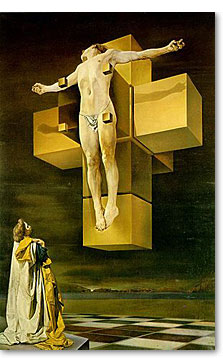
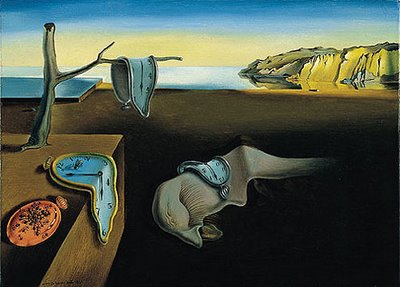
Crucifixion Dali painted this famous surrealist artwork in 1954. Crucifixion is a work from Salvador Dali's scientific period; he was very interested in math and physics. The painting depicts Jesus as being crucified upon an unfolded cube. The woman in the picture is Dali's wife, Gala. As for the background, it is Port Lligat, a village in Dali's childhood city of Catalonia. The Persistence of Memory This is Dali's bets known painting, and it was created in 1931. During this time in his life, he was influenced by psychoanalyst Sigmund Freud, and dream analysis had a great impact on his paintings. This piece epitomizes Dalí's theory of "softness" and "hardness." The watches are an unconscious symbol of the relativity of space and time. The orange clock at the bottom left of the painting is covered in ants; Dalí used ants as a symbol for death.The figure in the middle has one closed eye, suggesting that it is in a dream state. The clocks symbolize the passing of time as one experiences it in sleep.The Persistence of Memory employs techniques that depict imagery more likely to be found in dreams than in consciousness. |
