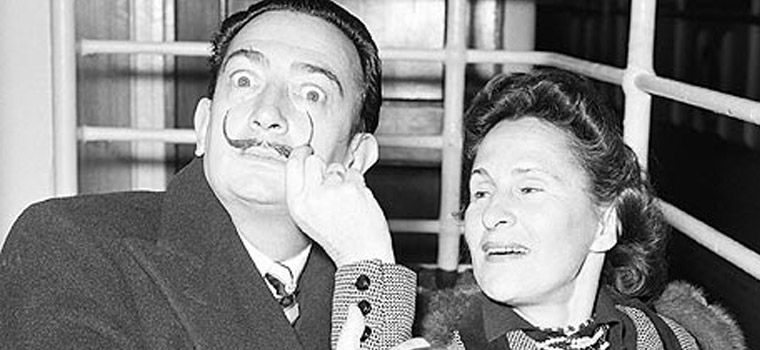
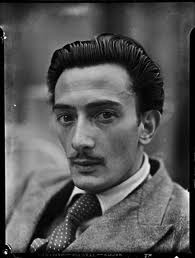
Salvador Dali (May 11, 1904 - Jan. 23, 1989) Salvador Dali was born in the small town of Figueras in Northern Spain. His talent showed at an early age and he received his first drawing lessons when he was 10 years old. Later on, Dali attended the Royal Academy of Art in Madrid. In 1928 Dali went to Paris where he met Pablo Picasso and Joan Miro. He established himself as the principal figure of surrealist artists grouped around Andre Breton, who was the "schoolmaster" of surrealism. Years later (1939) Breton turned away Dali from surrealism, accusing him of support of fascism, excessive self-presentation, and financial greediness. By 1929 Dali had found a personal style that made him famous - the world of the unconscious that is recalled during dreams; this is based on Freud's theories. Images of burning giraffes and melting watches became his trademarks. To evade World War II, Dali chose the U.S. as his permanent residence in 1940. In the US, he revised his strategy toward art and connected it with other traditions. He had a series of spectacular exhibitions. Besides creating great paintings, Dali received attention from the media by playing the role of a surrealist clown. Soon he became the darling of the American High Society; celebrities gave him commissions for portraits. In 1958 he began his series of large-sized history paintings. He made a monumental painting every year during the summer in Lligat. The most famous one is The Discovery of America by Christopher Columbus. Meeting Gala was the most important event in Dali's life and decisive for his future career. When he met her, she was married, but Gala decided to stay with Dali. She became his model in numerous artworks, his business manager, and a stabilizing factor of his life. For him, she was everything. In 1934, Dali and Gala were married. After Gala's death in 1982, Dali's health declined and he spent his final years as a recluse at his museum. He died on January 23, 1989 at his birthplace. Apart from painting, Dalí's output included sculpture, jewelery design, and work for the theatre. With the help of directors, he also made the first Surrealist films. He also wrote a novel and an autobiography. Although he is one of the most famous artists of the 20th century, his status is controversial; many critics consider that he did little after his classic Surrealist works of the 1930s. |
||
 |
 |
|
